

Engineered for High-Voltage, High-Temperature & Wear-Critical Applications
At Xinhuashunda (SD), we don’t just supply alumina ceramics — we engineer components that perform reliably in the most demanding industrial environments. From high-voltage insulation to extreme thermal shock resistance, our alumina solutions are designed to solve three critical engineering challenges:
Environmental Durability: Can the material withstand your specific chemical or thermal load?
Performance Stability: Will dielectric and mechanical properties remain consistent over 10,000+ hours?
Scalable Precision: Can complex geometries be manufactured with micron-level tolerances at scale?
With a fully integrated in-house production line — from raw material formulation to CNC precision machining — we ensure every component meets your exact performance, tolerance, and reliability requirements.
Why Engineers Choose SD Alumina Ceramics?
✔ In-house Material Control
We control purity (95%–99.8%), grain size, and density at the source. This reduces batch-to-batch variation and ensures your high-precision parts perform identically every time.
✔ Proven Stability in Extreme Conditions
Maintains superior electrical insulation and thermal conductivity (24–32 W/m·K) at operating temperatures up to 1000℃ without structural degradation.
✔ Specialized in Complex Geometries
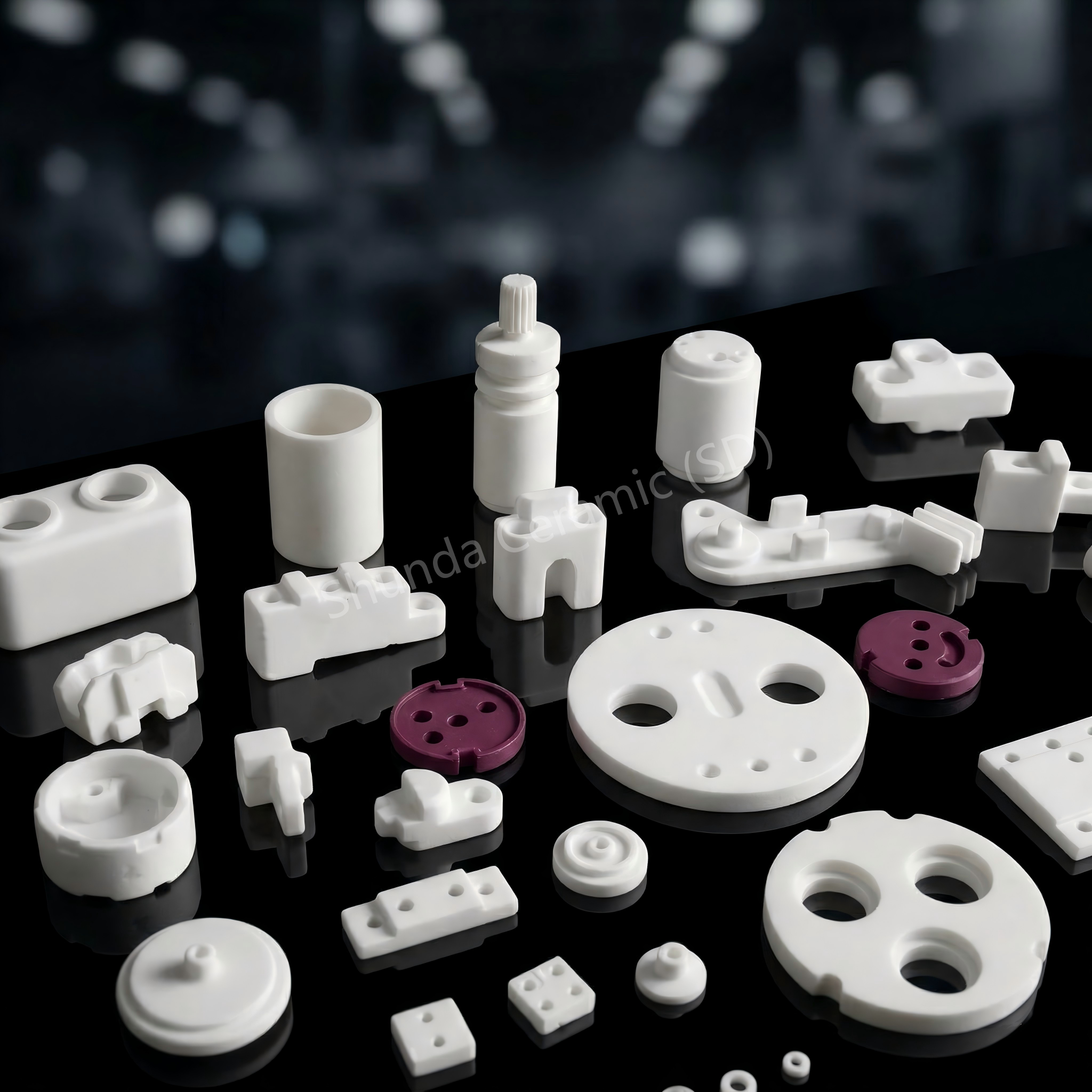
We specialize in high-precision ceramic insulators for thermostats, heater supports, sensor bodies, and medical probe handles with ultra-tight tolerances.
✔ Superior Chemical & Wear Resistance
In-house sintering creates a dense, non-porous microstructure resistant to acids, alkalis, and high-friction environments—extending component service life.
✔ Integrated Supply Chain Advantage
Unlike trading companies, we combine material synthesis and precision grinding in one facility. This means tighter quality control, lower costs, and 20% faster lead times.
Technical Capabilities & Forming Processes

By evaluating your application context and performance specifications, we ensure the most cost-efficient manufacturing solution is utilized.
Dry Pressing: Ideal for high-volume production of simple geometries with high consistency.
Hot Pressing: Used for high-density structural components requiring superior mechanical properties and minimal porosity.
Ceramic Injection Molding (CIM): Designed for highly complex, net-shape parts with intricate details and tight tolerances.
Comparative Material Properties & Engineering Benefits
Scroll horizontally to view full data on mobile.
*All data are typical values and can be customized based on specific additives and sintering processes.
From Prototype to Mass Production: Our Partnership Process
Selecting the right ceramic material is only the beginning. Our engineering team works closely with your R&D department to ensure manufacturability:
Material Selection: Guidance based on your specific dielectric and thermal environment.
Design Optimization: Adjusting shrinkage and tolerance for cost-efficient mass production.
Rapid Prototyping: Small batch validation before scaling to millions of units.
Quality Assurance: 100% inspection for critical dimensions using advanced OMM/CMM equipment.
Ready to Optimize Your Ceramic Components?
[ 📥 Download Our Full Material Grade Comparison Table (PDF) ]
[ ✉️ Request a 24h Manufacturability Review ]
[ 📤 Upload Your Drawing for a Precise Quotation ]
Technical FAQ (SEO & Quick Reference)
Q: What alumina purity level is best for my project?
A: 95%–96% Alumina is the "workhorse" for most industrial and thermostat applications due to its cost-efficiency. 99%+ is reserved for high-voltage insulation, semiconductor equipment, or environments requiring extreme chemical purity.
Q: Can you achieve tolerances tighter than +/- 0.1mm?
A: Yes. Through post-sintering diamond grinding, we regularly achieve tolerances as tight as ± 0.005 mm for critical industrial components.
Q: Do you offer ceramic-to-metal sealing or metallization?
A: Yes, we provide Mo-Mn metallization and nickel/gold plating services for customers requiring brazed ceramic-to-metal assemblies.